(más abajo, versión en español)
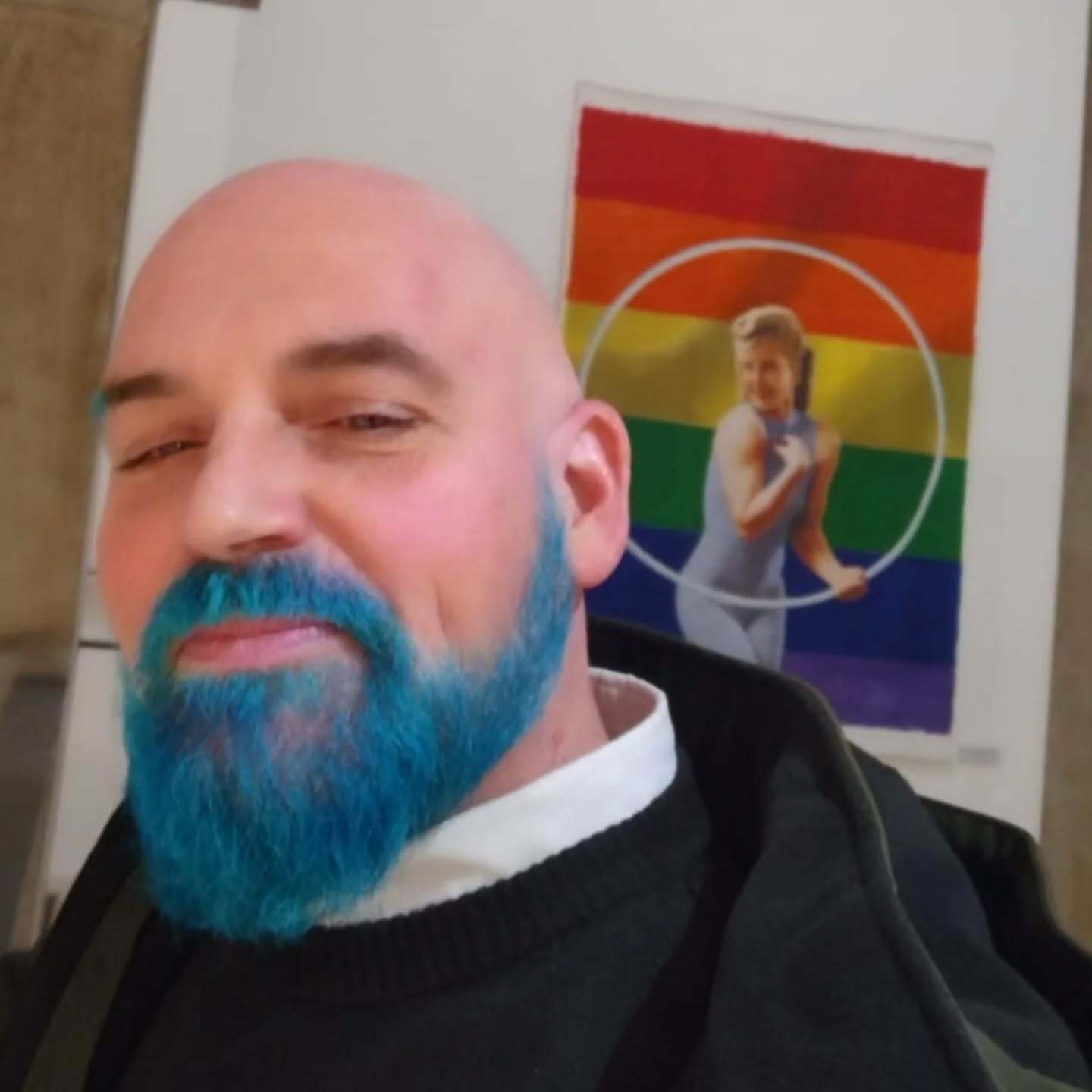
The idea was born on a map. My finger traced the long line from Buenos Aires to New York City, where an invitation to a United Nations Open Source event awaited me. In a sea of hundreds, how would I be remembered? I didn’t want to be just another delegate with a name tag. I wanted to be a conversation. So, I decided to dye my beard turquoise.
The process was an artistic ceremony. The artist carefully mixed the turquoise pigment. I went all in—not just the beard, but half of one eyebrow, a stroke of the absurd to complete the canvas. Looking in the mirror, I saw a different person: bold, playful, unmistakable. My turquoise beard. Some friends loved it; others were puzzled. To me, it was perfect.
New York greeted my turquoise beard with open curiosity. That first day was magic. On the streets of Manhattan, I was a walking icebreaker. Strangers smiled, pointed, and stopped to ask, “Why turquoise?” I told them about the fun and the desire to connect. The beard was doing its job—it was a flag of individuality, and people were saluting it. I felt seen.
On the second day, the purpose of the trip arrived. I walked to the towering glass and steel complex on the East River, my confidence buoyed by the previous day’s warmth. I approached the security checkpoint, invitation in hand.
The security officer, a woman with a practiced, neutral gaze, looked at my documents, then at my face. Her expression didn’t change. “I’m sorry, sir,” she said, her voice flat and final. “You cannot enter with that appearance.”
The world slowed down. I thought it was a language barrier issue, a misunderstanding. I smiled, waiting for the punchline. It never came. “Your appearance is not permitted for entry.”
A cold wave of disbelief washed over me. The event organizer approached to negotiate. He vouched for me, explained my invitation, and spoke about the color of my country’s flag, about diplomatic courtesy. The officer listened but did not bend. “The rules are clear,” she repeated. Her authority was absolute, a concrete wall against my abstract art.
In a frantic, whispered consultation, they asked if I could wash it out. “It’s permanent,” I said, hearing my own words taste like defeat. I stood there, blocked by a shade of turquoise. The choice was brutal, but simple: what to forfeit.
I turned and went back to the hotel. The irony was a bitter pill: the very key I thought I had created had slammed the door in my face. Standing before the bathroom mirror, I looked at that vibrant turquoise… and I chose.
I acted swiftly and obediently, but with sadness. The water carried away the remnants of my chosen identity. I shaved off half an eyebrow, too—a final, full surrender. The face that looked back was ordinary, tired, and compliant.
Minutes later, I returned to the security checkpoint, my skin raw and pale. The same officer checked my ID. She looked at my face, now plain and unobjectionable, and gave a curt nod. “You may proceed.”
I walked the polished corridors of the UN, a place dedicated to dialogue across differences. I had gained entry, but I felt a profound loss. I had traded a part of my voice for a seat at the table.
The event was insightful, but a question haunted me throughout: In spaces that govern our world, is there room for the flavor of turquoise?
My turquoise beard was born from a desire to be remembered. It disappeared as the price of admission to a place where, ironically, I became just another face in the crowd. I learned that before we can change the world, we must often first erase ourselves to fit through its door. The story of my turquoise beard is not one of a fairy-tale monster, but of a modern dilemma—where the line between self-expression and conformity is drawn, sometimes, by a security officer armed with the power of a cold rulebook.
Sometimes, the doors open only when you dilute yourself. Have your colors ever been a key… or a lock?
———
[ESPAÑOL]
La Barba Turquesa y la Puerta de la ONU: Una Historia de Arte, Reglas y Uniformidad
La idea nació sobre un mapa. Mi dedo recorría la larga línea desde Buenos Aires hasta Nueva York, donde me esperaba una invitación al evento Open Source de las Naciones Unidas. En un mar de cientos, ¿cómo me recordarían? No quería ser solo otro delegado con una credencial. Quería ser una conversación. Así que decidí teñirme la barba de turquesa.
El proceso fue una ceremonia artística. El artista mezcló con cuidado el pigmento turquesa. Me entregué por completo: no solo la barba, sino la mitad de una ceja, una pincelada de lo absurdo para completar el lienzo. Al mirarme al espejo, vi a una persona diferente: audaz, lúdica, inconfundible. Mi barba turquesa. A algunos amigos les encantó; a otros les desconcertó. Para mí, era perfecta.
Nueva York recibió a mi barba turquesa con curiosidad abierta. El primer día fue mágico. Por las calles de Manhattan, era un rompehielos ambulante. Extraños sonreían, señalaban y se detenían para preguntar: “¿Por qué turquesa?” Les hablaba sobre la diversión y el deseo de conectar. La barba cumplía su cometido: era una bandera de individualidad, y la gente la saludaba. Me sentí visto.
Al segundo día, llegó el propósito del viaje. Caminé hacia el imponente complejo de cristal y acero a orillas del East River, mi confianza reforzada por la calidez del día anterior. Me acerqué al control de seguridad, invitación en mano.
La oficial de seguridad, una mujer con una mirada práctica y neutral, revisó mis documentos y luego mi rostro. Su expresión no cambió. “Lo siento, señor”, dijo, con una voz plana y definitiva. “No puede ingresar con esa apariencia”.
El mundo se ralentizó. Pensé que era un problema de idioma, un malentendido. Sonreí, esperando el remate, que nunca llegó. “No está permitida su apariencia para el ingreso”.
Una ola fría de incredulidad me invadió. El organizador del evento se acercó a negociar. Dio fe de mí, explicó mi invitación y habló del color de la bandera de mi país, de cortesía diplomática. La oficial escuchó, pero no cedió. “Las reglas son claras”, repitió. Su autoridad era absoluta, un muro de concreto contra mi arte abstracto.
En una consulta frenética y susurrada, me preguntaron si podía lavármela. “Es permanente”, dije, escuché mis propias palabras con sabor a derrota. Me quedé allí bloqueado por un tono turquesa. La elección era brutal, pero simple: a qué renunciar.
Di media vuelta y volví al hotel. La ironía era una píldora amarga: la misma llave que creí crear, me había cerrado la puerta en mi cara. Frente al espejo del baño, miré ese vibrante turquesa… y elegí.
Actué rápido y obediente, pero triste. El agua se llevó los restos de mi identidad elegida. Me afeité la mitad de la ceja también, una rendición total y final. El rostro que me devolvió la mirada era ordinario, cansado y dócil.
Minutos después volví al control de seguridad, con la piel enrojecida y pálida. La misma oficial revisó mi identificación. Miró mi rostro, sencillo y sin objeciones, y asintió con la cabeza. “Puede pasar”.
Caminé por los pulidos corredores de la ONU, un lugar dedicado al diálogo entre diferencias. Había logrado entrar, pero sentí una pérdida profunda. Había intercambiado una parte de mi voz por un asiento en la mesa.
El evento fue esclarecedor, pero una pregunta me persiguió durante toda la estadía: ¿En los espacios que gobiernan nuestro mundo, hay lugar para el sabor turquesa?
Mi barba turquesa nació del deseo de ser recordado. Desapareció como precio de entrada a un lugar donde, irónicamente, me convertí en otro rostro más en la multitud. Aprendí que antes de poder cambiar el mundo, a menudo debemos borrarnos primero para pasar por su puerta. La historia de mi barba turquesa no es la de un monstruo de cuento de hadas, sino la de un dilema moderno: donde la línea entre la expresión personal y la conformidad la traza, a veces, un oficial de seguridad con el poder de un frío reglamento.
A veces, las puertas sólo se abren cuando te diluyes. ¿Tus colores fueron alguna vez una llave… o un candado?